



A well-integrated restaurant system could boost your business growth by 25% and help you save over $8,000 each month in labor costs.
Restaurant expansion brings excitement along with its share of challenges. Many restaurants struggle with consistency between locations, which often leads to failure during scaling. Your restaurant’s survival depends on robust expansion strategies.
The path to growth starts with a thorough assessment of four vital elements: your current outlet’s performance, cash position, debt situation, and operational capabilities. These foundations must be solid because scaling without them will only magnify your losses instead of profits.
Your restaurant’s expansion needs more than just new locations (from one outlet to many outlets). A comprehensive business plan should blend centralized operations with the same quality and dining experience that made your first location thrive.
Let’s explore how you can grow from one restaurant to many without creating chaos. We’ll guide you through every step – from checking your readiness to measuring your success along the way.
Evaluate Your Readiness to Expand
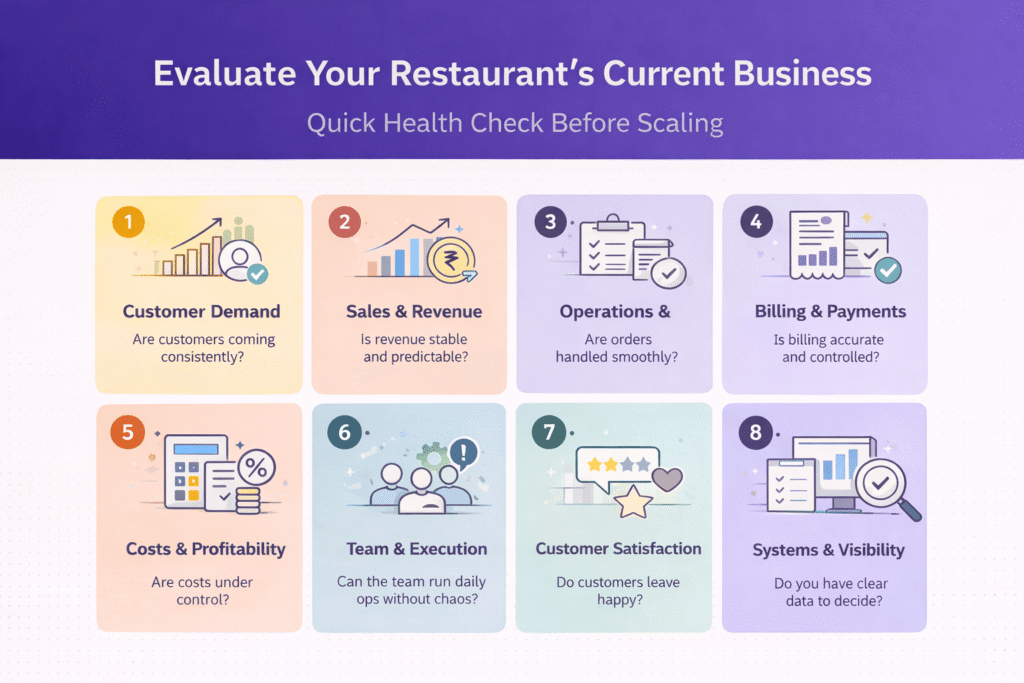
The restaurant industry competition has never been more fierce—45% of restaurant owners expect tougher competition in 2024 than last year. My business needs to be ready before I start thinking about expansion.
Review current outlet performance
The financial health of my restaurant tells me if it’s ready to expand. I need to learn about my restaurant’s profit consistency and sales growth in the last 12+ months. The core metrics show if my business stands on solid ground:
→ Consistent revenue streams across months and quarters → Strong profit margins after covering labor, rent, and food costs → Stable cash flow to support both existing operations and new location costs
More than 60% of top-performing establishments use at least three KPIs to make daily decisions. My net profit margin shows if my business can handle new locations.
Analyze customer satisfaction and retention
My expansion potential depends heavily on customer satisfaction. A small 5% boost in customer loyalty can increase profits by up to 25%. These metrics need tracking:
→ Customer retention rates – loyal customers spend more and bring friends→ Customer Lifetime Value (CLV) – calculated as expenditure per guest per month divided by monthly customer churn rate
A single lost customer costs between €400-€1,000 in potential returns. On top of that, loyalty programs, reservation systems, and payment solutions give us applicable information about customer behavior patterns.
Set clear goals for expansion
My restaurant’s expansion needs specific, achievable objectives. The SMART framework (Specific, Measurable, Achievable, Relevant, Time-bound) helps turn big ideas into real goals.
New locations need careful evaluation based on competition levels, customer density, and accessibility. The brand image and service quality must stay consistent across all locations to succeed.
Regular reviews of my restaurant’s performance indicators help me stay aligned with expansion goals. This lets me adjust strategies based on changing conditions.
Build a Scalable Restaurant Expansion Plan
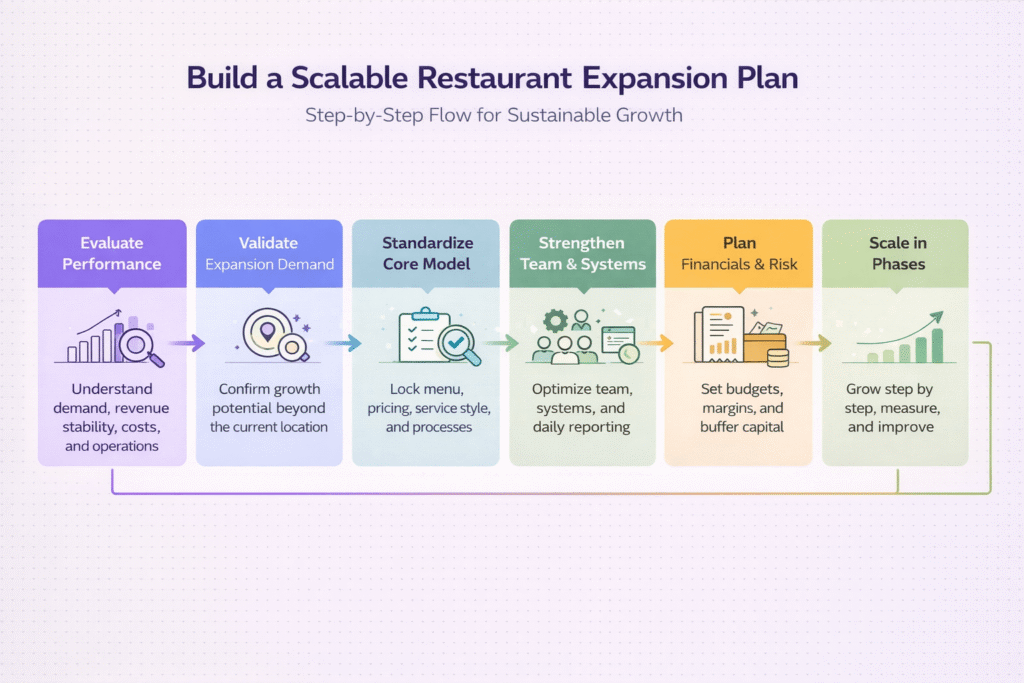
Your readiness to expand needs a well-laid-out expansion plan that becomes your roadmap to growth. A restaurant’s expandable solutions need careful planning to avoid depending too much on the owner’s personal involvement.
Choose the right expansion model
The right expansion approach is a vital part of your long-term success. Industry experts suggest three main options:
→ Opening a single new location – Perfect to test your concept in a new market → Opening multiple locations simultaneously – Often needs investor backing → Franchising your brand – Lets you expand quickly with less financial risk
The life-blood of successful expansion lies in building a business model that propels development without quality loss. Your concept’s strengths—signature dishes, service style, or unique atmosphere—need consistent replication.
Create a detailed restaurant expansion business plan
A business plan works as both your roadmap and communication tool with potential investors. This document should include:
Executive summary outlining your vision and strategy Restaurant description explaining your concept Sample menu showcasing your offerings Market analysis showing market chances Financial projections proving viability
Your funding requirements, capital use, and expected returns need clear statements. Restaurant investors want proof that your plan makes financial sense. Getting financing through SBA loans, commercial loans, or private investors needs solid financial documentation.
Select tools and systems for multi-location management
Technology centralizes operations and helps manage multiple restaurants. Modern restaurant management platforms should merge:
Point of Sale (POS) systems that do more than process transactions Inventory management software that tracks stock levels live Customer Relationship Management (CRM) platforms that personalize experiences
These merged systems give you the visibility to monitor performance from one central dashboard. Restaurant management software lets you control menus, staff, orders, and coverage for all branches at once.
Standardize Operations Without Losing Flexibility
Restaurants face a basic challenge when expanding to multiple locations – how to standardize their operations. Data shows that restaurants using clear SOPs have up to 30% higher staff retention.
Unify menu and service standards
SOPs are the foundations of consistency. They serve as your recipe for success and outline everything from food preparation to customer service protocols. You should implement:
→ Detailed SOP manuals with updates twice a year→ Digital systems that make standards available on mobile devices→ Unified menu management to keep information consistent on all platforms
Train staff with consistent onboarding programs
Your staff is your biggest asset, even with the best systems in place. Good training will give your operation the precision it needs:
→ Detailed onboarding plus ongoing learning opportunities→ Role-playing exercises to practice real-life situations→ Cross-training to improve versatility and operational knowledge
Adapt to local priorities while keeping brand identity
“Glocalization” helps you balance global brand standards with local tastes:
→ Adjust recipes to match regional tastes while keeping your brand’s essence→ Think over religious and cultural factors that influence food choices→ Marketing strategies should align with local traditions and values
Note that standardization isn’t about being rigid – it creates a framework where excellence becomes repeatable throughout your expansion experience.
Track Progress and Adjust as You Grow
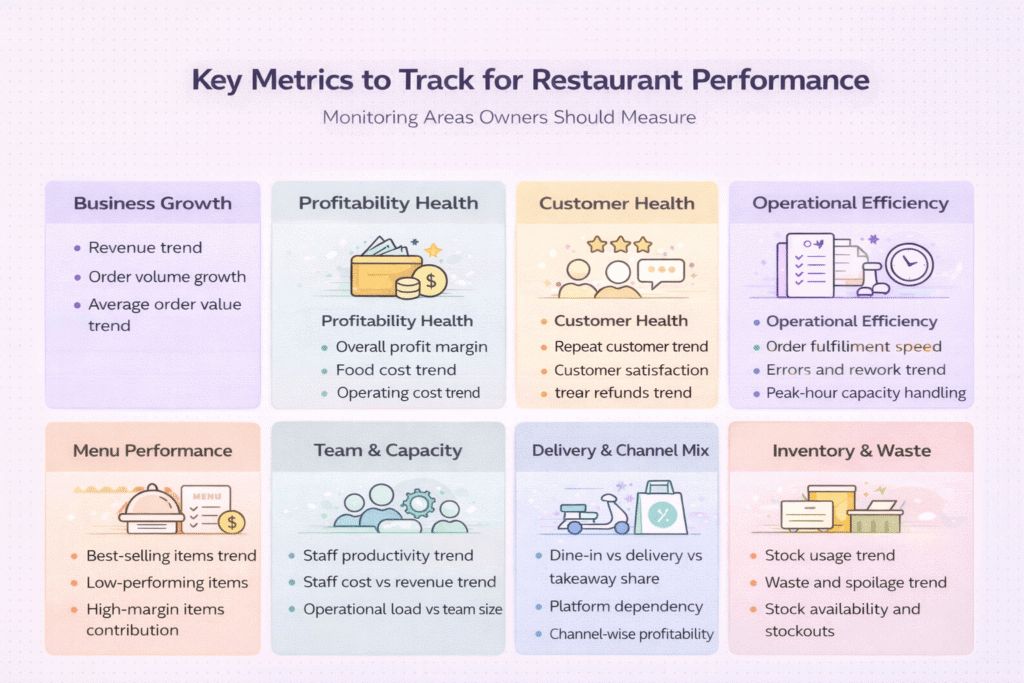
Analytics-based restaurant management transforms expansion from a gamble into a strategic move. Studies show companies using analytical insights have a 23-fold higher chance of acquiring new customers and a 6-fold better customer retention rate.
Monitor key performance indicators
Restaurant expansion success relies on tracking the right metrics at every location. These metrics matter most:
→ Sales and profit margins show overall financial health → Table turnover rates reveal seating efficiency
→ Food cost percentage – a mere 4% difference could mean hundreds of thousands in yearly losses
Smart software solutions give us immediate insights into performance metrics. This helps us tackle problems as they emerge.
Conduct regular audits across locations
Regular audits protect your brand – they’re not just paperwork. The benefits of scheduled audits include:
→ Problems surface early before harming your reputation → Solutions happen quickly when issues arise → Progress stays consistent over time
Monthly or quarterly audits work best for most restaurants. This schedule balances detail with practicality.
Refine your restaurant expansion strategies based on data
Restaurant audits work best as an ongoing process rather than a one-time task. Regular data collection and analysis reveals:
→ Patterns emerge between locations → Improvement areas stand out clearly → Analytical decisions lower risks while boosting customer satisfaction
Industry experts say advanced analytics typically delivers a 3:1 return on investment.
Conclusion
Growing your restaurant business is exciting but challenging. You need careful planning to expand from one location to many. The right approach will help you avoid the chaos that comes with quick growth.
Before you add new locations, take an honest look at your current restaurant. Make sure it makes money and keeps customers happy. These two factors tell you if you’re ready to grow.
Your growth plan should be detailed yet adaptable. The way you expand – through direct ownership or franchising – will affect your future success. You must pick the right management systems to keep control of multiple locations.
Standard procedures create consistency without losing your restaurant’s special touch. Good documentation helps new staff deliver quality service that customers expect. You can still adapt to local markets to keep your concept fresh.
Numbers are your best friend as you grow. Track how each location performs to spot issues early and make things better. Remember that every successful chain started with just one place – yours could be next.
Making your restaurant bigger isn’t the only goal – it’s about improving too. Smart planning, good execution, and adjusting based on real numbers will help your restaurant grow while keeping its original charm.
Key Takeaways
Restaurant expansion success hinges on methodical planning, operational consistency, and data-driven decision making to avoid the chaos that destroys 45% of scaling attempts.
• Evaluate readiness first: Ensure 12+ months of consistent profits, strong cash flow, and customer satisfaction before expanding to new locations.
• Choose the right expansion model: Select between single locations, multiple simultaneous openings, or franchising based on your financial capacity and risk tolerance.
• Standardize without sacrificing flexibility: Create comprehensive SOPs and training programs while adapting to local preferences to maintain brand identity.
• Track performance religiously: Monitor KPIs like profit margins, table turnover, and food costs across all locations to spot issues early and optimize operations.
• Leverage integrated technology: Use centralized POS, inventory, and CRM systems to manage multiple locations efficiently and maintain operational control.
Remember, successful restaurant expansion isn’t about getting bigger—it’s about getting better. Every major restaurant chain started with just one location, and with the right strategy, yours could be next.
FAQs
Q1. What are the key factors to consider before expanding a restaurant business?
Before expanding, evaluate your current outlet’s performance, including consistent profits over 12+ months, strong cash flow, and high customer satisfaction. Also, set clear expansion goals and choose the right expansion model for your business.
Q2. How can technology help in managing multiple restaurant locations?
Integrated restaurant management systems can significantly aid in multi-location management. These include centralized POS systems, inventory management software, and CRM platforms that allow you to control menus, staff, orders, and reporting for all branches from one central dashboard.
Q3. What is the importance of standardization in restaurant expansion?
Standardization is crucial for maintaining consistency across multiple locations. It involves creating comprehensive SOPs, implementing unified menu and service standards, and developing consistent staff training programs. This helps ensure that the quality and dining experience remain consistent as you expand.
Q4. How can a restaurant adapt to local preferences while maintaining brand identity?
Restaurants can practice “glocalization” by modifying recipes to accommodate regional tastes while keeping the brand’s essence intact. It’s important to consider local cultural and religious conventions that influence food choices and ensure marketing strategies respect local traditions.
Q5. Why is data tracking important in restaurant expansion?
Data tracking is essential for successful expansion as it allows you to monitor key performance indicators across all locations. This includes metrics like sales, profit margins, table turnover rates, and food cost percentages. Regular audits and data analysis help identify issues early, spot patterns, and make informed decisions to refine your expansion strategies.