


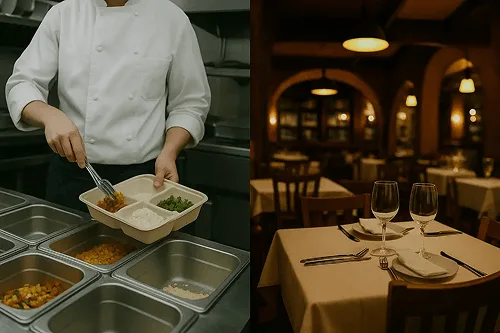
When deciding between a cloud kitchen restaurant and a traditional dine-in establishment, first-time owners face a critical choice that impacts their investment, profitability, and long-term success. The global cloud kitchen market, valued at $43.1 billion in 2019, is expected to reach $71.4 billion by 2027, growing at an impressive CAGR of 12%. Meanwhile, the broader food industry is projected to grow at 3.9% between 2020 and 2025.
For new entrepreneurs, the cloud kitchen startup cost ranges from $10,000 to $100,000, significantly lower than traditional restaurants that typically require $200,000 to $500,000+. This dramatic difference in initial investment makes cloud kitchens increasingly attractive for those with limited capital.
Beyond startup costs, the operational models differ substantially in profitability and efficiency. Cloud kitchens generally enjoy higher profit margins (10–25%) compared to dine-in establishments (5–15%). Additionally, cloud kitchens can break even within 6-12 months, while traditional restaurants usually take 18-36 months to reach the same milestone. This faster return on investment is partly due to lower overhead costs and reduced staffing needs, with cloud kitchens requiring only 2-5 employees versus the larger teams needed for dine-in operations.
In this guide, we’ll examine both business models in detail to help you determine which option aligns best with your goals, resources, and vision as a first-time food business owner. We’ll cover everything from initial investment and operational costs to scalability potential and customer experience considerations.
Business Model Overview:
Cloud Kitchen vs Restaurant
The food service industry has evolved rapidly with technology, creating two distinct operational paths for entrepreneurs. Understanding these models thoroughly before launching your first food business is essential for long-term success.

What is a Cloud Kitchen?
A cloud kitchen (also called ghost kitchen, virtual kitchen, or dark kitchen) operates as a delivery-only food establishment with no physical dining space or storefront. These commercial kitchens are designed specifically for preparing food for delivery and takeout orders through online platforms or third-party delivery apps like UberEats, DoorDash, and Grubhub.
The fundamental characteristics of cloud kitchens include:
- Delivery-only business model with no dine-in option
- Lower overhead costs due to minimal space requirements (200-800 sq. ft.)
- Focus on digital ordering systems and delivery logistics
- Ability to host multiple restaurant brands from one kitchen
- Minimal staff requirements (typically 2-5 employees)
Cloud kitchens operate in low-rent areas but close to densely populated locations, making them accessible to delivery services while keeping operational costs low. Furthermore, they rely heavily on technology integration for order management, inventory control, and customer data analysis.
What is a Traditional Restaurant?
Traditional restaurants represent the conventional food service model with physical storefronts where customers can dine in. They offer a complete dining experience that includes ambiance, waitstaff service, and often a bar. These establishments typically require larger spaces (1,500-4,000 sq. ft.) and more staff to manage both front and back-of-house operations.
A traditional restaurant focuses on creating memorable experiences through:
- Physical dining space with branded atmosphere
- High-touch customer service and personal interaction
- Diverse revenue streams including dine-in, takeout, events, and catering
- Strong local community engagement and presence
- Full-service staff including hosts, servers, and kitchen personnel
According to industry observations, customers often visit traditional restaurants not just for the food but for experiences that are difficult to replicate at home. This experiential aspect forms a core part of the traditional restaurant’s value proposition.
Key Differences in Business Approach
The fundamental difference between these models lies in their operational focus. Cloud kitchens prioritize efficient food production and delivery logistics, whereas traditional restaurants emphasize customer experience and service quality.
Cloud kitchens can operate multiple brands from one location, allowing entrepreneurs to experiment with different cuisines and target various customer segments simultaneously. In contrast, traditional restaurants typically maintain a single brand identity and menu concept, focusing on consistency and customer loyalty through in-person experiences.
For first-time owners, each model presents distinct advantages in terms of time-to-market. Cloud kitchens can be established in 2-6 weeks, making them ideal for entrepreneurs looking to launch quickly. Conversely, traditional restaurants require more extensive planning and setup, often taking 3-6 months before opening.
The customer relationship dynamics also differ considerably between models. Cloud kitchens interact with customers primarily through digital channels and delivery services, with virtually no face-to-face interaction. This reduces the opportunity for personal connection but opens possibilities for data-driven customer insights and targeted marketing approaches.
Essentially, choosing between these models requires careful consideration of your vision, resources, and long-term business goals. Cloud kitchens offer lower barriers to entry and greater operational flexibility, while traditional restaurants provide stronger brand presence and experiential value.
Cost of Entry:
Which is More Affordable?
The financial investment required to launch a food business represents one of the most critical factors for first-time entrepreneurs. The stark contrast in startup costs between cloud kitchens and traditional restaurants often becomes the deciding factor for many new owners.
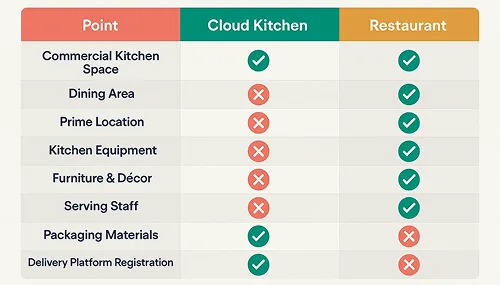
Cloud Kitchen Startup Cost vs Restaurant
For aspiring food entrepreneurs with limited capital, cloud kitchens offer a significantly more affordable entry point. The total initial investment for a cloud kitchen in India typically ranges from ₹5-8 lakhs for a small setup to approximately ₹11.47 lakhs for a more comprehensive operation. In contrast, traditional restaurants demand a much heavier financial commitment—between ₹16.87-42.19 lakhs, primarily due to expenses related to dining areas and customer-facing infrastructure.
The cost difference becomes more apparent when examining specific expense categories:
Rent and Location: Cloud kitchens can operate from non-prime locations in spaces as small as 300-500 sq. ft., with monthly rent ranging from ₹20,000-₹50,000 in metro cities and just ₹8,000-₹10,000 in tier II/III cities. Restaurant locations, however, require high-foot-traffic areas with rent often between ₹1-3 lakhs monthly.
Equipment and Interiors: Cloud kitchen equipment costs typically range from ₹6-9 lakhs, focusing purely on cooking efficiency. Traditional restaurants need not only kitchen equipment but also substantial investment in dining furniture, décor, and ambiance—adding ₹10-25 lakhs to the initial outlay.
Licensing: Cloud kitchens require fewer permits, costing approximately ₹40,000 for necessary government licenses. Restaurants need more extensive licensing, including health and safety permits for dining spaces and potentially liquor licenses.
Hidden Costs to Watch Out For
First and foremost, many first-time owners underestimate operational expenses beyond the initial setup. For cloud kitchens, these often include:
- Delivery Platform Commissions: Third-party platforms typically charge 15-30% per order, significantly impacting profitability
- Packaging Costs: Initial investment of ₹40,000-₹60,000, plus ongoing expenses based on order volume
- Digital Marketing: Essential budget of ₹30,000-₹80,000 since there’s no physical storefront visibility
For traditional restaurants, unexpected expenses often include:
- Maintenance and Equipment Repair: Commercial kitchen equipment servicing is costly but essential for uninterrupted operations
- Breakage and Inventory Loss: Ongoing replacement of glassware, dishware, and stolen items
- Energy Consumption: Higher utility costs for dining areas requiring lighting, heating/cooling, and ventilation
- Professional Services: Accounting fees for managing complex financial operations
Cloud Kitchen Setup Cost Optimization Tips
To minimize your cloud kitchen investment costs without compromising quality:
- Choose Location Strategically: Upper floors of commercial buildings or less prominent areas can lead to significant rent savings without affecting delivery operations
- Consider Shared Kitchens: Fully equipped industrial kitchen spaces available on rent reduce initial equipment costs
- Purchase Second-Hand Equipment: Platforms like OLX offer good condition used equipment at fraction of new prices
- Start with Essentials: Begin with basic equipment—gas burners/oven, refrigeration, storage racks, and essential cooking utensils
- Maintain Reserve Capital: Set aside ₹1-1.5 lakhs as operating reserve for unforeseen expenses during initial months
Overall, the accessibility of cloud kitchens makes them particularly attractive for first-time owners with limited capital. Their substantially lower initial investment, faster setup time, and reduced ongoing expenses provide a financially prudent entry point into the food service industry.
Cost Comparison
| Expense Category | Cloud Kitchen (India) | Restaurant (India) | Cloud Kitchen (USA)* | Restaurant (USA)* |
|---|---|---|---|---|
| Total Setup Cost | ₹5–8 lakh (small) ₹11.47 lakh (comprehensive) | ₹16.87–42.19 lakh | $20k–$35k | $150k–$500k |
| Rent & Location (monthly) | ₹20k–₹50k (metro) ₹8k–₹10k (tier II/III) | ₹1–3 lakh | $1.5k–$4k | $8k–$20k |
| Equipment & Interiors | ₹6–9 lakh (kitchen only) | ₹16–34 lakh (kitchen + furniture + décor) | $15k–$25k | $80k–$250k |
| Licensing | ~₹40k | ₹1–3 lakh (varies with liquor license) | $500–$2k | $3k–$15k |
| Packaging Setup | ₹40k–₹60k | ₹10k–₹25k | $500–$1k | $300–$1k |
| Digital Marketing Setup | ₹30k–₹80k | ₹30k–₹80k | $500–$2k | $500–$3k |
Operational Expenses and Overheads
The day-to-day running costs represent a crucial factor in determining the long-term viability of your food business. Beyond initial setup, these ongoing expenses directly impact your bottom line and potential for success.

Kitchen Expenses: Utilities and Maintenance
Cloud kitchens typically enjoy substantially lower utility costs compared to traditional restaurants. Without spacious dining areas requiring constant lighting, heating, and cooling, cloud kitchens can operate with utility expenses ranging from ₹5,000 to ₹1.68 lakhs monthly. These costs vary based on kitchen size and order volume.
For maintenance, industry experts recommend allocating 1.5% to 3% of annual revenue for both business models. Nevertheless, the maintenance burden differs significantly:
- Cloud Kitchens: Focus solely on kitchen equipment maintenance
- Traditional Restaurants: Must maintain both kitchen and dining areas
Preventive maintenance proves more cost-effective than reactive approaches. Emergency repairs typically cost 2-3 times more than scheduled maintenance. Moreover, equipment breakdowns lead to revenue loss from operational downtime.
Labor Costs: Minimal vs Full-Service Staff
Perhaps the most striking operational difference between these models lies in staffing requirements:
- Cloud Kitchens: Operate efficiently with just 2-5 employees
- Traditional Restaurants: Require extensive teams for both kitchen and front-of-house roles
This translates directly to monthly salary expenses:
- Cloud Kitchen: ₹1-2 lakhs/month
- Traditional Restaurant: ₹3-5 lakhs/month
The restaurant industry typically allocates 25-35% of total revenue toward labor costs. Consequently, cloud kitchens gain a significant advantage through their streamlined staffing model—requiring only kitchen staff without servers, hosts, or cleaning personnel for dining areas.
Delivery Platform Fees vs In-House Service Costs
For cloud kitchens, delivery platform partnerships are essential yet costly. Major platforms like Uber Eats and DoorDash typically charge commission fees ranging from 15% to 30% per order[56]. These fees can substantially impact profitability.
A ₹4,219 order with a 20% platform commission results in an ₹843 reduction from your revenue. Beyond commissions, additional service and processing fees (typically 2-4% per transaction) further eat into margins.
Traditional restaurants face different service-related costs:
- Staffing expenses for servers and hosts
- Training costs for customer-facing roles
- Higher cleaning and maintenance expenses
Several strategies can help mitigate delivery costs for cloud kitchens:
- Negotiate lower commission rates with platforms
- Encourage direct ordering through your website
- Consider hiring your own delivery personnel
A comprehensive understanding of these operational differences allows first-time owners to make informed decisions based on their financial capacity and business goals. The lower overhead costs of cloud kitchens provide distinct advantages for entrepreneurs with limited capital, though each model offers unique benefits depending on your vision and resources.
Cost Comparison
| Expense Category | Cloud Kitchen (India) | Restaurant (India) | Cloud Kitchen (USA)* | Restaurant (USA)* |
|---|---|---|---|---|
| Rent | ₹20k–₹50k | ₹1–3 lakh | $1.5k–$4k | $8k–$20k |
| Staff Wages | ₹60k–₹1.5 lakh | ₹2–6 lakh | $8k–$15k | $35k–$80k |
| Utilities | ₹8k–₹15k | ₹30k–₹80k | $200–$500 | $2k–$5k |
| Packaging | ₹20k–₹50k | ₹5k–₹25k | $500–$1.5k | $200–$500 |
| Marketing | ₹10k–₹30k | ₹15k–₹50k | $300–$800 | $500–$2k |
| Maintenance & Misc. | ₹5k–₹15k | ₹15k–₹40k | $200–$500 | $1k–$3k |
| Delivery Platform Commissions | 15–30% of sales | 10–20% (if used) | 15–30% of sales | 10–20% (if used) |
Setup Time
& Launch Speed
Time represents one of the most valuable assets for first-time food business owners. The speed at which you can transform your concept into an operational business directly impacts your market entry strategy and initial revenue generation opportunities.
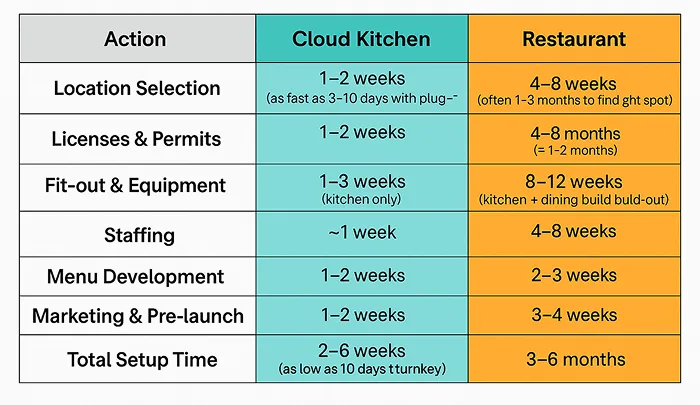
Cloud Kitchen:
2–6 Weeks Setup
The streamlined nature of cloud kitchens allows for remarkably fast deployment. Once you secure a kitchen space and obtain necessary licenses, you can launch operations within a few weeks. This accelerated timeline stems from several key factors:
- Minimal Infrastructure Requirements: Without dining areas to design and construct, setup focuses exclusively on kitchen functionality
- Focused Equipment Needs: Only kitchen equipment procurement is necessary, eliminating the need for dining furniture and décor
- Simplified Compliance: Fewer regulatory requirements apply to delivery-only operations
Many cloud kitchen service providers offer even faster options. Some platforms provide fully equipped, plug-and-play kitchen spaces where entrepreneurs can begin operations in as little as 10 days. These turnkey solutions handle compliance and operational setup, allowing owners to focus exclusively on menu development and marketing.
Restaurant:
3–6 Months Setup
Traditional restaurants demand significantly more time before opening their doors to customers. The typical restaurant setup process spans 3-6 months, with more elaborate concepts potentially requiring even longer. This extended timeline reflects several complex requirements:
- Location Selection: Finding the right storefront with appropriate visibility and foot traffic can take 1-3 months
- Extensive Construction: Designing and building both kitchen and dining areas requires 2-4 months
- Comprehensive Staffing: Hiring and training both kitchen and service staff adds 1-2 months to the timeline
- Interior Design: Creating the right ambiance and dining experience requires additional planning and execution time
First-time restaurant owners often underestimate the time required for obtaining permits and licenses (1-2 months) and equipment installation (2-4 weeks).
Impact on Time-to-Market for First-Time Owners
For entrepreneurs making their initial entry into the food business, setup time dramatically affects both risk exposure and opportunity capture:
- Capital Efficiency: Faster launch with cloud kitchens means quicker revenue generation while minimizing the period of pure investment
- Market Responsiveness: Cloud kitchens allow owners to capitalize on emerging food trends before they peak
- Concept Testing: The shorter setup timeline enables entrepreneurs to test culinary concepts without extended financial commitment
- Risk Reduction: Less time between concept and launch reduces exposure to changing market conditions
The ability to launch multiple brands from a single cloud kitchen location further amplifies these advantages, allowing first-time owners to experiment with different concepts simultaneously without the extended setup time each would require as a standalone restaurant.
Ultimately, for entrepreneurs seeking the fastest route to market, cloud kitchens provide clear advantages with their focused operational model and streamlined setup requirements.
[Comparison table: Cloud Kitchen vs Restaurant Setup Timeline]
Profitability
& Break-Even Timeline
Profitability ultimately determines the success of any food business venture, with the two models offering distinctly different financial trajectories for first-time owners.
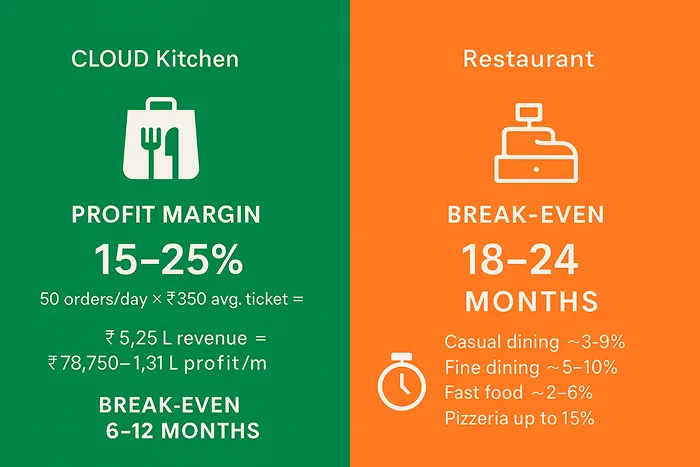
Cloud Kitchen Profit Margin: 15–25%
Cloud kitchens typically achieve higher profit margins primarily because of their streamlined operational model. With properly optimized operations focused on delivery-first business, cloud kitchens can achieve net profit margins ranging from 15-25%. This impressive profitability stems from minimal overhead costs and the ability to reinvest savings into food quality and order volume.
For instance, a cloud kitchen with 50 daily orders averaging ₹350 each could generate monthly revenue of approximately ₹5.25 lakhs. After accounting for all expenses, this translates to monthly profits between ₹78,750-₹1.31 lakhs.
Restaurant Profit Margin: 5–15%
Traditional restaurants typically operate with tighter margins. Full-service restaurants generally achieve profit margins between 5-15%, with the industry average hovering around 3-5%. Different restaurant types show varying profitability:
- Fine dining: 5-10%
- Casual dining: 3-9%
- Fast food/QSR: 2-6%
- Pizzerias: Up to 15% (among the highest)
These lower margins reflect the substantial overhead costs associated with maintaining dining spaces, higher staffing requirements, and extensive equipment maintenance.
Break-Even Point: 6–12 Months vs 18–24 Months
The time required to recover your initial investment varies substantially between these business models. Cloud kitchens typically reach break-even within 6-12 months of operation, assuming proper management and steady order volume. This faster recovery occurs because the initial investment is significantly lower.
In contrast, traditional restaurants generally require 18-24 months to break even, with some taking up to 36 months depending on location, concept, and operational efficiency. This extended timeline directly correlates with higher startup costs and operational expenses.
Is Cloud Kitchen Profitable in India?
Indeed, cloud kitchens have demonstrated strong profitability in India. With average profit margins of 20-25%, they represent an attractive business model in the Indian market. A typical cloud kitchen in India handling 25-50 daily orders priced between ₹200-250 can generate monthly income of ₹2-4 lakhs.
One key consideration: food delivery platforms like Swiggy and Zomato typically charge 20-25% commission plus GST. Factoring these fees into your pricing strategy remains essential for maintaining profitability. Despite these commissions, cloud kitchens still maintain higher profit margins than traditional restaurants through their streamlined operations and lower overhead expenses.
Scalability
& Expansion Potential
Scaling a successful food business remains the ultimate goal for many first-time owners. The path to expansion varies dramatically between business models, with each offering distinct advantages and challenges.
Multi-Brand Cloud Kitchens from One Location
Cloud kitchens excel at expansion through their inherent flexibility. One of their most compelling advantages is the ability to operate multiple virtual brands from a single kitchen space. This multi-brand approach allows entrepreneurs to target diverse customer segments simultaneously without additional real estate investments.
A centralized cloud kitchen can effortlessly house several distinct restaurant concepts, each with its own menu and identity. This strategy enables rapid experimentation with new cuisines and market segments. Notably, a single cloud kitchen running multiple brands can significantly increase revenue potential by catering to diverse customer preferences.
For example, one kitchen might simultaneously operate:
- An Italian pasta brand
- A burger concept
- A healthy bowl offering
This setup maximizes kitchen utilization and spreads fixed costs across multiple revenue streams. Many successful operators use shared resources across brands—common ingredients, equipment, and staff—to streamline operations and boost efficiency.
Restaurant Expansion: High CapEx and Time
Traditional restaurants face more substantial challenges when scaling. Each new location requires finding appropriate real estate, replicating the atmosphere, and ensuring consistent dining experiences across venues. This process demands significant capital expenditure and extensive planning.
Restaurant expansion typically follows one of two paths:
- Direct expansion: Opening new company-owned locations, requiring full capital investment for each site
- Franchising: Partnering with investors who assume much of the financial burden but share in profits
Above all, restaurant scaling demands adherence to strict standards. As industry experts note, “Don’t open your second location until your first one proves the model works”. Successful restaurant groups follow this golden rule, focusing on perfecting operations before attempting replication.
Which Model Scales Faster?
Cloud kitchens undoubtedly offer faster scaling potential, primarily due to:
- Lower entry barriers: New locations require 75-80% less capital than traditional restaurants
- Rapid deployment: New kitchen setups can be operational in weeks rather than months
- Operational flexibility: The ability to quickly adapt menus and concepts based on market demand
The hub-and-spoke model represents an especially effective scaling strategy for cloud kitchens. This approach utilizes a central production kitchen that supports multiple smaller satellite locations. Such centralized operations ensure consistency while maximizing geographical coverage.
For first-time owners seeking rapid growth, cloud kitchens provide a clear advantage through their digital-first model, minimal overhead, and multi-brand potential.
[Table: Expansion Metrics Comparison]
| Metric | Cloud Kitchen | Traditional Restaurant |
| New Location Setup Time | 2-6 weeks | 3-6 months |
| Expansion Capital Required | Low-Medium | High |
| Multi-Brand Potential | High | Limited |
| Scaling Model | Digital-first | Location-dependent |
Customer Experience
& Brand Building
Customer experience forms the cornerstone of any food business, yet the approach to delivering that experience differs fundamentally between cloud kitchens and traditional restaurants.
In-Person Dining vs Delivery-Only Experience
Traditional restaurants offer multi-sensory experiences that cloud kitchens simply cannot replicate. In fact, dining out isn’t merely about eating—it encompasses the whole journey including ambiance, service, and personal interactions. Restaurants provide physical spaces where customers can celebrate special occasions, conduct business meetings, or enjoy casual outings with loved ones.
Alternatively, cloud kitchens prioritize efficient delivery and packaging over direct customer interaction. Without a physical storefront, their only touchpoints with customers occur through delivery apps and packaging. This limited interaction creates unique challenges for brand connection.
Building Loyalty: Ambiance vs Packaging
For traditional restaurants, ambiance plays a critical role in creating memorable experiences. A well-designed space, friendly staff, and excellent dining atmosphere make significant differences in customer perception. Important to realize, ambiance affects guests’ perception of the food, service, and overall experience, transforming simple meals into memorable events.
Conversely, cloud kitchens must focus on packaging as their primary brand ambassador. For these businesses, packaging acts as the sole physical representative of their brand. Quality packaging not only maintains food integrity but also creates positive first impressions that encourage repeat orders. For one thing, creative packaging can grab attention and make products more appealing through unique shapes, colors, and materials.
| Element | Traditional Restaurant | Cloud Kitchen |
| Primary touchpoint | In-person service | Packaging & delivery |
| Brand communication | Ambiance & staff | Digital channels & packaging |
| Experience type | Multi-sensory | Convenience-focused |
Impact on Repeat Business
Customer loyalty drives sustainable business success in both models. A 5% increase in customer retention can boost profits by 25% to 95%. Although the paths to achieving loyalty differ significantly between models.
Traditional restaurants build long-term customer loyalty through rich, sensory experiences that foster deep customer connections. At the same time, cloud kitchens must drive loyalty digitally, relying on consistency, quality packaging, and prompt delivery to encourage repeat business.
First thing to remember: if your concept thrives on human connection and community, traditional restaurants provide that advantage. In essence, if efficiency and convenience are your priority, cloud kitchens better serve that purpose.
Marketing &
Technology Integration
Marketing approaches differ dramatically between business models, with each requiring unique strategies to attract and retain customers in today’s digital-first dining landscape.
Cloud Kitchen Marketing: SEO, Delivery Apps
Marketing success for cloud kitchens hinges primarily on digital visibility. With 89% of people researching dining options on their phones, cloud kitchens must optimize their online presence. Effective strategies include:
- Hyper-local SEO targeting neighborhood-specific keywords
- Strategic delivery platform advertising, which can yield 3.2x returns
- Micro-influencer partnerships generating superior engagement at lower costs
Restaurant Marketing: Local Ads and Events
Traditional restaurants benefit from physical visibility alongside digital presence. Local marketing creates meaningful community relationships, with 72% of consumers preferring businesses that share their values. Successful restaurant marketing typically involves:
- Sponsoring local sports teams to increase brand awareness
- Participating in food festivals to showcase signature dishes
- Distributing targeted flyers, which yield 1-5% success rates
Technology Tools: POS, CRM, Inventory Systems
Technology integration has become essential for both models, yet implementation varies significantly:
| Technology | Cloud Kitchen | Traditional Restaurant |
| POS Systems | Integration with multiple delivery platforms | Focus on in-person transactions |
| CRM Tools | Digital-only customer tracking | Both in-person and online engagement |
| Inventory | Real-time tracking linked to order volume | Broader inventory management |
For cloud kitchens, POS systems integrate with delivery partners, creating a centralized ecosystem that eliminates redundancy. Restaurants benefit from CRM solutions that help build stronger relationships, particularly valuable as repeat customers now account for 35% of online orders.
Comparison Table
Cloud Kitchen vs Traditional Restaurant Comparison
| Aspect | Cloud Kitchen | Traditional Restaurant |
| Initial Investment | ₹5-8 lakhs (small setup) to ₹11.47 lakhs | ₹16.87-42.19 lakhs |
| Monthly Rent | ₹20,000-₹50,000 (metro cities) | ₹1-3 lakhs |
| Space Requirement | 200-800 sq. ft. | 1,500-4,000 sq. ft. |
| Staff Size | 2-5 employees | Full team (kitchen + front-of-house) |
| Monthly Staff Cost | ₹1-2 lakhs | ₹3-5 lakhs |
| Setup Timeline | 2-6 weeks | 3-6 months |
| Profit Margins | 15-25% | 5-15% |
| Break-even Period | 6-12 months | 18-36 months |
| Equipment Cost | ₹6-9 lakhs | ₹10-25 lakhs (including interiors) |
| Marketing Focus | Digital platforms, delivery apps | Local advertising, physical presence |
| Customer Experience | Delivery-only | Full dining experience |
| Expansion Potential | Faster scaling, multiple brands possible | Location-dependent, higher capital needed |
| Operating Hours | Flexible, delivery-focused | Fixed hours, dine-in focused |
| Location Requirements | Non-prime areas acceptable | High-footfall areas necessary |
| Additional Revenue Streams | Multiple virtual brands | Events, catering, bar service |
Conclusion
The stark contrast between cloud kitchens and traditional restaurants presents first-time food entrepreneurs with a pivotal decision. Throughout this analysis, we’ve seen how cloud kitchens offer significantly lower startup costs (₹5-11.47 lakhs versus ₹16.87-42.19 lakhs for restaurants), reduced staffing needs, faster setup times, and higher profit margins. Undoubtedly, these advantages make cloud kitchens an attractive option for those with limited capital seeking rapid market entry.
Nevertheless, traditional restaurants still hold their ground through irreplaceable in-person experiences, stronger community connections, and diverse revenue streams beyond just food sales. Though requiring more substantial investment, restaurants provide opportunities for creating memorable dining atmospheres that delivery-only models simply cannot replicate.
Your choice ultimately depends on your specific goals and resources. Cloud kitchens clearly win if your priorities include minimizing initial investment, achieving faster profitability, and maintaining operational flexibility. On the contrary, restaurants remain the better choice when your vision centers around creating immersive experiences, building face-to-face customer relationships, or establishing a visible community presence.
First-time owners should honestly assess their financial capacity, culinary vision, and long-term business aspirations before deciding. Actually, many successful entrepreneurs now adopt hybrid models, starting with cloud kitchens to test concepts before expanding into brick-and-mortar locations once they’ve proven their menu and built customer loyalty.
Regardless of which path you choose, success in the food industry still hinges on food quality, consistent execution, and responsive customer service. Whether through efficient delivery or memorable dining experiences, satisfying customer expectations remains the foundation of any thriving food business. The modern food industry offers room for both models to succeed, provided they align with your entrepreneurial vision and resources.
Key Takeaways
For first-time food entrepreneurs, understanding the fundamental differences between cloud kitchens and traditional restaurants is crucial for making an informed business decision that aligns with your resources and goals.
• Cloud kitchens require 70% less startup capital (₹5-11 lakhs vs ₹17-42 lakhs for restaurants) and achieve profitability 2-3x faster with 6-12 month break-even periods
• Higher profit margins favor cloud kitchens at 15-25% compared to restaurants’ 5-15%, primarily due to minimal overhead costs and streamlined operations
• Setup speed creates competitive advantage – cloud kitchens launch in 2-6 weeks versus 3-6 months for restaurants, enabling faster market entry and revenue generation
• Scalability differs dramatically – cloud kitchens can operate multiple brands from one location and expand rapidly, while restaurants require significant capital for each new location
• Customer experience models are fundamentally different – restaurants excel at creating memorable in-person experiences, while cloud kitchens focus on delivery efficiency and digital engagement
The choice ultimately depends on your financial capacity, business vision, and long-term goals. Cloud kitchens offer lower risk and faster returns for capital-constrained entrepreneurs, while restaurants provide stronger community presence and experiential value for those seeking to build lasting customer relationships through immersive dining experiences.
FAQs
Q1. What are the main differences between a cloud kitchen and a traditional restaurant?
Cloud kitchens are delivery-only establishments with no dining space, focusing on efficient food production and delivery. Traditional restaurants offer a full dining experience with physical storefronts. Cloud kitchens have lower startup costs, higher profit margins, and faster break-even times, while restaurants provide stronger brand presence and in-person customer experiences.
Q2. How much does it typically cost to start a cloud kitchen?
The initial investment for a cloud kitchen in India typically ranges from ₹5-8 lakhs for a small setup to approximately ₹11.47 lakhs for a more comprehensive operation. This is significantly lower than the ₹16.87-42.19 lakhs usually required for traditional restaurants.
Q3. What are the profit margins like for cloud kitchens compared to traditional restaurants?
Cloud kitchens generally enjoy higher profit margins, ranging from 15-25%, compared to traditional restaurants which typically see 5-15% profit margins. This difference is largely due to lower overhead costs and streamlined operations in cloud kitchens.
Q4. How long does it take to set up a cloud kitchen versus a traditional restaurant?
Cloud kitchens can be established in 2-6 weeks, making them ideal for entrepreneurs looking to launch quickly. In contrast, traditional restaurants require more extensive planning and setup, often taking 3-6 months before opening.
Q5. What are the main challenges of running a cloud kitchen?
Key challenges for cloud kitchens include heavy reliance on delivery platforms and their associated fees (15-30% commission per order), limited direct customer interaction for brand building, and the need for effective digital marketing strategies. Additionally, maintaining food quality and consistency during delivery is crucial for success.
1 Response on this post
Comments are closed.