



Restaurant billing errors are costing your business more than you might realize. Over 60% of restaurants report losing sales due to POS-related issues, while each wrong order results in $25-45 of food waste. Unfortunately, the impact doesn’t stop there.
When looking at the restaurant billing process, the consequences of errors compound quickly. Servers lose 20-30% in tips from unhappy customers, and it takes 15-20 minutes to fix each wrong order. Furthermore, 17% of diners never return after just one bad experience, and 89% are likely to try a competitor after repeated mistakes. Manual billing systems are particularly problematic, prone to incorrect calculations, wrong item entries, and overlooked discounts.
We’ve identified 5 Proven Ways that can dramatically reduce these costly mistakes in your restaurant. From implementing digital systems to creating better communication protocols, these solutions address the root causes of billing errors without requiring a complete operational overhaul. Let’s explore how you can protect your profits and improve customer satisfaction with some straightforward changes.
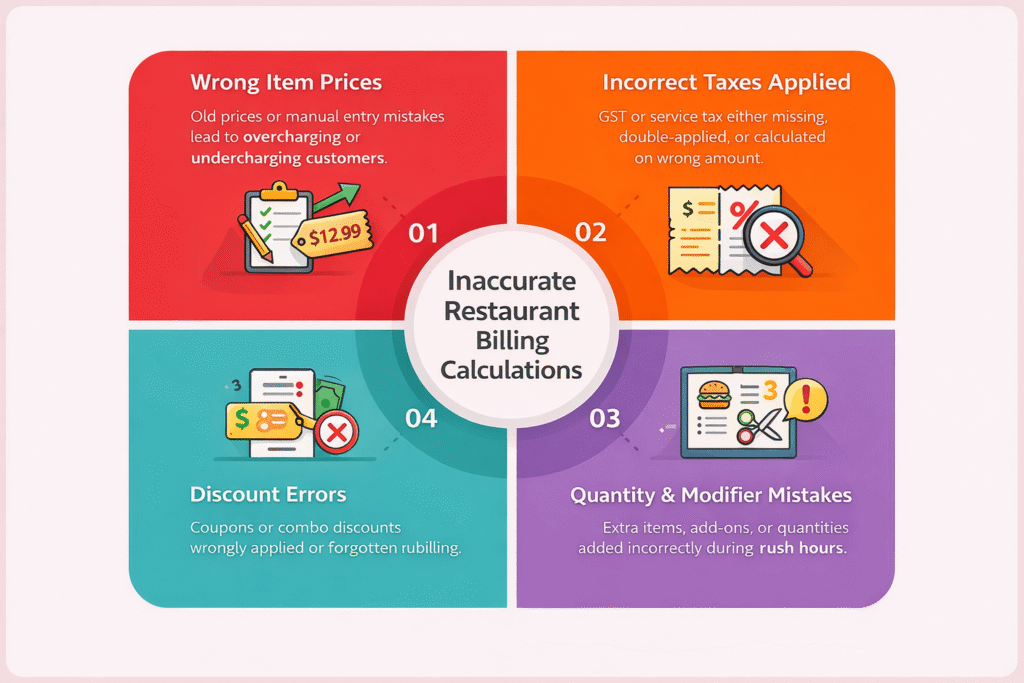
Inaccurate Restaurant Billing Calculations
“If the restaurant is operating at a 31% cost-of-goods-sold percentage (equal to the inaccurate standard cost), the manager is most likely satisfied but unfortunately unaware that $30,000 a year is being wasted or stolen.” — Menu Cover Depot Resource Center, Restaurant industry resource and cost control expert
Behind every restaurant bill is a complex calculation process that can easily go wrong. Billing errors are far more common than most restaurant owners realize, silently draining [thousands in revenue each month](https://www.mentorpos.com/3-hidden-costs-killing-your-restaurant-profits-that-pos-fixes-overnight/). Let’s examine what these errors look like, why they happen, and how to stop them from eating into your profits.
What inaccurate restaurant billing is?
Inaccurate restaurant billing occurs when there’s a discrepancy between what customers order and what they’re charged. These errors take multiple forms:
- Missed items during billing – Food or drinks that never make it onto the final bill
- Incorrect pricing – Charging the wrong amount for menu items
- Unauthorized discounts – Staff applying discounts without approval
- Wrong tax application – Incorrect GST/tax calculations
- Cash-handling mistakes – Errors in processing cash payments
These small discrepancies may seem insignificant individually, but they collectively add up. A single mis-keyed digit can throw off inventory counts and cost reports. Even small repeated mistakes—like missing ₹10 add-ons or minor calculation errors—can lead to thousands of rupees lost monthly.
Inaccurate financial data doesn’t just affect your bottom line; it impacts your entire operation. When your data is inconsistent, it becomes impossible to plan effectively. Additionally, billing errors can trigger financial audits and damage relationships with lenders, investors, and stakeholders.
Why billing errors happen?
Several factors contribute to restaurant billing errors:
Manual billing processes are inherently error-prone. Handwriting bills or manually calculating totals leads to missed items, wrong totals, incorrect quantities, and wrong discount calculations—especially during busy periods. In fact, manual bill generation often results in calculation errors that can significantly impact revenue.
Peak hour pressure creates the perfect environment for mistakes. During rush hours, staff may hurry orders, skip add-ons, or apply incorrect rates simply to keep queues moving. This accelerated pace increases the likelihood of errors across the board.
Manual data entry is another major culprit. Typing invoices into spreadsheets consumes valuable time and invites errors. Operators who track these activities report that a single mistyped digit can cascade into larger accounting problems.
Lack of standardized processes also contributes significantly. Without standardized billing procedures, each staff member might handle transactions differently, creating inconsistencies throughout your operation.
Price fluctuations and updates create confusion when not properly communicated. Restaurants frequently charge outdated prices because staff forget updated rates, leading to undercharging, price mismatches, and customer confusion.
Poor communication between front and back of house results in order discrepancies that ultimately appear on bills. This communication breakdown creates billing errors before the calculation even begins.
How to fix billing errors in restaurants?
Implementing effective solutions can dramatically reduce billing errors:
Invest in a modern POS system to standardize billing and remove manual intervention from critical revenue points. Modern systems ensure prices, taxes, and discounts are pre-configured and applied automatically, guaranteeing accuracy across every transaction. Restaurant billing software automates calculations, applies taxes correctly, and ensures accurate bill generation every time.
Implement mandatory protocols within your system, such as:
- Required item selection before order completion
- Locked pricing to prevent unauthorized changes
- Automated tax calculations based on compliance rules
- Detailed audit trails for every bill and modification
Double-check orders by cross-checking what was recorded with what was served to ensure accuracy. This simple verification step can catch many errors before they reach the customer.
Verify calculations by confirming that all item totals, taxes, and discounts are calculated correctly. Even with automated systems, occasional verification helps maintain accuracy.
Update menus regularly to ensure your billing system reflects the latest prices. This prevents mismatches that confuse customers and affect profitability. Maintain one master price list and update all menus (printed and digital) whenever prices change.
Conduct daily bill audits to catch discrepancies early. Many restaurant owners skip this crucial step, leading to unnoticed errors, fraud, and accounting problems. Establish a rhythm of processing invoices as they arrive, often with digital approval workflows that managers can access from anywhere.
Use cloud-based tools to automate reconciliation between your POS system and accounting software. This ensures daily sales reports match deposits and eliminates manual matching.
Integrate your invoice processing with your accounting and inventory systems. This creates a closed loop where every ingredient purchased updates stock counts automatically, and every payment ties directly to your books.
Once billing becomes system-driven, restaurants see immediate improvements in revenue accuracy and daily collections. Although transitioning to digital systems requires an initial investment, the return comes quickly through recovered revenue and improved operational efficiency.
Order Entry Mistakes by Staff

Even the most experienced restaurant staff can make costly mistakes when entering orders. These errors represent a significant source of revenue loss, with a single order entry mistake potentially consuming 66% of a product’s price. For restaurants operating on thin margins, these seemingly minor errors can quickly compound into major financial problems.
What order entry mistakes are?
Order entry mistakes occur whenever there’s a discrepancy between what a customer orders and what gets entered into the restaurant’s system. These errors manifest in several ways:
- Transposition errors – Entering numbers in the wrong sequence (like typing 465 instead of 456)
- Missing items – Forgetting to include all ordered items
- Duplicated orders – Entering the same item multiple times
- Incorrect quantities – Entering wrong amounts of ordered items
- Wrong modifiers – Selecting incorrect add-ons, sides, or cooking preferences
- Pricing discrepancies – Entering incorrect prices for items
These errors occur at critical moments in the restaurant service process. According to industry data, order entry errors happen most frequently during peak hours when staff are overwhelmed with multiple tasks. The consequences extend beyond simple miscalculations—incorrect orders lead to food waste, customer dissatisfaction, and operational inefficiencies that impact your entire restaurant.
Why staff make order entry errors?
Several factors contribute to order entry mistakes in restaurant environments:
Human fatigue and distraction play a major role in error rates. Consider a typical scenario: staff members process upwards of 30 orders daily, involving numerous data points for each transaction. As the day progresses, mental fatigue sets in, increasing the likelihood of mistakes. Imagine your team double-clicking the same screen area for the 347th time while customers are waiting—mental checkout becomes inevitable.
Work environment factors significantly impact accuracy. Research shows that uncomfortable workspaces directly affect employee performance. Factors like noise distractions (neighboring conversations, kitchen sounds), inadequate lighting, and ergonomic issues can all contribute to mistakes.
System-related issues often trigger errors. Outdated software, confusing interfaces, or miscommunication between different systems create confusion that results in inaccurate orders. Many restaurants still rely on manual entry processes that multiply the chances for human error.
Workload pressure creates a perfect environment for mistakes. During rush periods, staff may hurry through order entry simply to keep queues moving. This accelerated pace compromises accuracy, especially when combined with understaffing—a common challenge in today’s restaurant industry. If your establishment is chronically understaffed, team members become overworked, dramatically increasing error frequency.
Inadequate training remains one of the primary causes of order entry mistakes. Many staff members lack proper understanding of the restaurant’s systems or fail to recognize the importance of accurate data entry. Without clear processes and protocols, team members develop inconsistent approaches to order entry.
How to reduce order entry mistakes?
Implementing strategic solutions can dramatically decrease order entry errors:
Automate whenever possible. Replace manual data entry with digital tools that eliminate repetitive tasks. Modern POS systems with order validation features catch potential errors before they’re finalized, confirming that items exist and quantities are reasonable. OCR (Optical Character Recognition) and EDI (Electronic Data Interchange) technologies can further reduce manual entry requirements.
Standardize your order entry workflows to ensure consistency across all staff members. Create clear, step-by-step processes with:
- Pre-set templates for common order types
- Uniform data entry methods
- Automated validation rules
- Required fields that must be completed before submission
Invest in staff training focused specifically on data accuracy. Help employees understand the real-world impact of entry errors on both customers and the business. Show them actual examples of how small mistakes lead to significant problems. Regular refresher sessions keep accuracy top-of-mind.
Create a positive work environment conducive to focus and attention. Simple improvements like:
- Proper lighting to reduce eye strain
- Ergonomic workstations with wrist support
- Regular breaks to combat mental fatigue
- Adequate staffing levels to manage workload effectively
Implement quality assurance checks at critical points. Designate team members responsible for verifying order details before finalization. These additional review steps might include verbal order confirmation with customers or double-checking complex orders. Using simple checklists during the review process ensures nothing gets overlooked.
Leverage technology smartly. Modern restaurant management systems offer features like:
- Inventory integration that prevents ordering out-of-stock items
- Customer profile access that shows previous orders and preferences
- Real-time order tracking to keep everyone informed about order status
The path to reducing order entry errors requires both technical solutions and human-focused improvements. Restaurants that address both aspects typically see significant reductions in errors, leading to improved customer satisfaction and healthier profit margins. Ultimately, investing in accuracy pays dividends through reduced waste, fewer comped meals, and increased customer loyalty.
Miscommunication Between Front and Back of House

The divide between front and back of house creates fertile ground for costly billing errors in restaurants. Within these two worlds—where customer engagement happens up front and food production occurs in the kitchen—disconnects form daily, affecting accuracy, service quality, and ultimately the bottom line.
What miscommunication looks like in restaurants?
Miscommunication between front of house (FOH) and back of house (BOH) manifests in various problematic ways:
Order confusion and errors occur daily in restaurant operations. Remarkably, 62% of restaurant workers report that miscommunication about customer orders between these departments happens regularly. These breakdowns typically appear as:
- Servers attempting substitutions that kitchens cannot accommodate
- Misunderstandings about special requests or dietary restrictions
- Orders entered incorrectly or with missing modifications
- Items dying in the window because nobody’s running food
- Stacked tickets overwhelming the kitchen all at once
Inventory mismanagement creates additional friction. FOH staff often continue selling items that BOH knows are unavailable, leading to awkward customer interactions alongside wasted time. Without proper communication channels, inventory status remains unclear, resulting in promises that cannot be fulfilled.
Timing conflicts emerge as another critical issue. FOH prioritizes speed of service to maximize customer satisfaction, whereas BOH focuses primarily on food quality. This fundamental difference in priorities creates tension, particularly during peak hours.
Last-minute changes represent perhaps the most disruptive form of miscommunication, with 55.75% of restaurant workers identifying them as their top operational challenge. These changes disrupt kitchen workflows and ultimately impact billing accuracy.
Why FOH and BOH miscommunication occurs?
Several key factors contribute to persistent communication problems:
Different priorities create natural friction. Front-of-house staff, often working for tips, feel frustrated by perceived kitchen slowness or food quality issues since these directly impact their earnings. Meanwhile, kitchen staff become irritated when servers stack tickets or make continuous interruptions during busy service periods.
Inadequate communication systems fail to bridge operational gaps. Reliance on outdated methods—handwritten tickets, verbal order modifications, or memory-based processes—significantly increases error potential. Without standardized communication protocols, critical information gets lost between departments.
Heavy workloads amplify communication problems, with 48% of US workers and 58.5% of Canadian workers identifying this as a key driver of interdepartmental tensions. Under pressure, both teams have less bandwidth for clear communication, leading to shortcuts and mistakes.
Lack of mutual understanding forms the foundation of many conflicts. Each team perceives itself under greater pressure than the other, with 72.25% of workers identifying inefficient communication as the primary source of tension. Notably, 53.75% of restaurant staff report regular stress from these interdepartmental conflicts.
Physical separation between work areas makes communication inherently challenging. Restaurant layouts often create natural divides between FOH and BOH, making quick conversations difficult during service.
How to improve communication between FOH and BOH?
Implementing strategic solutions can dramatically improve cross-departmental communication:
Implement clear communication protocols by establishing standardized procedures for order modifications, special requests, and inventory updates. Develop consistent methods for communicating critical information, including:
- Specific channels for different types of updates
- Standard terminology for common situations
- Clear escalation paths for resolving conflicts
Hold regular briefings before each shift to align everyone on daily specials, ingredient changes, and potential challenges. These pre-shift meetings ensure both teams start with shared understanding and expectations.
Leverage technology solutions like kitchen display systems (KDS) that connect directly with your POS system. Modern restaurant technologies enable:
- Instant updates from FOH to BOH
- Real-time inventory status visibility
- Digital ticket management that eliminates miscommunication
- Streamlined order modification processes
Create cross-training opportunities to help each team understand the other’s challenges. When servers understand kitchen constraints and chefs experience front-of-house pressure firsthand, mutual respect develops naturally.
Establish regular check-ins during service to address emerging issues before they escalate. Quick huddles or designated communication points prevent small misunderstandings from becoming major problems.
Implement standardized workflows with clear checklists for service readiness, communication procedures, and inventory updates. Documented processes remove ambiguity and ensure consistency regardless of who’s working.
Encourage feedback and solutions rather than blame when issues arise. Creating an environment where staff focus on problem-solving rather than finger-pointing leads to continuous improvement in communication practices.
The direct impact of improved FOH-BOH communication extends beyond operational smoothness—it measurably reduces billing errors. When orders are communicated clearly from the start, every subsequent step in the service and billing process becomes more accurate. Consequently, investing in better communication systems and practices protects revenue, improves customer satisfaction, and creates a more positive work environment overall.
Errors Due to Manual Billing Systems

“One of the most effective strategies to prevent billing errors is to move away from manual invoicing processes. Digital invoicing systems, often integrated with” — Clo Touch, Business billing and error prevention expert
Many restaurant operators consider traditional pen-and-paper billing an economical choice, yet manual billing systems silently drain profits day after day. What appears to be a cost-saving decision often turns into a significant financial leak—with [losses potentially exceeding ₹50,000 annually](https://www.mentorpos.com/the-real-cost-of-manual-billing-why-restaurants-lose-%E2%82%B950000-annually/) for small and mid-sized establishments. This silent revenue erosion happens gradually, making it difficult to detect without proper analysis.
What manual billing errors are
Manual billing errors occur whenever there’s a discrepancy in the billing process due to human handling of calculations or record-keeping. These errors take various forms:
- Missed items – Food or beverages served but never added to bills
- Incorrect calculations – Mathematical errors in totaling orders
- Wrong pricing – Using outdated or incorrect prices
- Unauthorized discounts – Staff applying discounts without approval
- Cash handling issues – Incorrect change or unrecorded cash sales
Unlike digital systems that provide safeguards, manual billing lacks alerts for missing items, enforced order flows, or verification that every item served appears on bills. Even a conservative estimate reveals the financial impact—missing just ₹150 worth of items daily results in annual losses exceeding ₹54,000. Most concerning is that these losses remain virtually invisible, scattered across hundreds of small transactions rather than appearing as obvious red flags.
Why manual billing leads to mistakes?
Several fundamental weaknesses make manual billing inherently error-prone:
Human error forms the foundation of most problems. Restaurant staff processing dozens of orders daily inevitably make mistakes, particularly during busy periods. These errors multiply with fatigue and pressure, creating a cumulative effect that impacts profitability. Manual calculations lead to arithmetic mistakes that often go unchecked.
Excessive control without oversight creates opportunities for unauthorized actions. Manual billing gives staff significant freedom to apply informal discounts—either to please customers, reward friends, or simply expedite transactions. Without centralized monitoring, owners remain unaware of how frequently these discounts occur or whether they were justified.
Time constraints exacerbate accuracy issues. During peak hours, staff may rush calculations or skip verification steps just to keep service flowing. This pressure leads to consistent revenue leakage without clear documentation. Ultimately, delayed billing extends table turnover times, reducing total daily revenue potential.
Record-keeping challenges compound over time. Manual systems make reconciliation time-consuming and stressful, leading many operators to normalize small daily discrepancies rather than investigating them. This practice gradually erodes profit margins while damaging trust within teams.
Lack of integration between systems creates additional friction points. Manual billing exists in isolation from inventory management, customer data, and financial reporting. This separation makes it nearly impossible to track inventory accurately, manage customer information effectively, or generate reliable financial reports.
Data integrity issues hinder decision-making. Manual billing produces unreliable sales data that makes it difficult to identify what’s selling, which items generate profits, or which time periods maximize revenue. Without accurate information, critical business decisions rely on assumptions rather than facts.
How to switch to digital restaurant billing systems?
Transitioning from manual to digital billing requires careful planning but delivers immediate benefits:
Start with assessment and preparation. Before implementing new systems, evaluate your current billing processes to identify specific pain points and inefficiencies. Are your staff spending excessive time on data entry? Do you notice frequent invoice errors? Understanding these challenges helps tailor your transition strategy.
Back up existing data before beginning any migration. This critical step prevents information loss during the transition. Additionally, notify your staff about upcoming changes and provide necessary training before full implementation to ensure a smoother process.
Choose the right digital solution for your specific needs. Modern restaurant billing software offers:
- Automated calculations for taxes, discounts, and other adjustments
- Accurate order transmission between front and back of house
- Precise inventory tracking that updates in real-time
- Digital audit trails for every transaction and modification
Focus on implementation best practices. Successful transitions require:
- Creating a detailed action plan with clear timelines
- Involving key stakeholders from finance, IT, and customer service
- Providing comprehensive staff training on the new system
Conduct parallel operations initially. Run both manual and automated systems simultaneously for a short period to verify accuracy and identify any issues. This approach reduces risks while building confidence in the new system.
Monitor and optimize after implementation. Review system performance regularly and address any concerns promptly. Most restaurants see immediate benefits—even during the transition period—including fewer calculation errors, faster service, and improved customer satisfaction.
The investment in digital billing systems quickly pays for itself through recovered revenue, reduced errors, and improved operational efficiency. Many restaurant operators report that digital systems reduce human error dramatically, resulting in accurate bills, satisfied customers, and an enhanced reputation for reliability.
Lack of Order Confirmation Processes

Order confirmation processes are often overlooked safeguards that can prevent costly restaurant billing errors before they occur. Research shows that well-designed confirmation systems can significantly improve operational efficiency, increase customer satisfaction, and protect your bottom line. Let’s explore how implementing proper order verification can transform your restaurant’s accuracy and profitability.
What order confirmation means in restaurants?
In restaurants, order confirmation refers to a systematic verification process that ensures customer orders are accurately received, processed, and prepared before delivery. This critical step includes:
- Verifying product details and quantities
- Confirming customer delivery information
- Double-checking special requests and modifications
- Validating payment methods and billing information
- Ensuring kitchen availability for requested items
A complete order confirmation process serves multiple functions. First and foremost, it acts as a digital receipt, providing immediate acknowledgment that an order was received. Moreover, it serves as both a tracking hub and a point of connection between customers and your restaurant.
Effective confirmation systems must balance thoroughness with simplicity. The layout should remain clean, the information easily scannable, and the tone consistent with your brand identity. Most importantly, these confirmations should happen in real-time—customers expect immediate acknowledgment after placing an order.
Why confirming orders reduces errors?
Order confirmation represents the first and most crucial step in preventing billing errors and reducing returns. Through proper verification, restaurants can realize several key benefits:
Primarily, confirmation processes ensure customers genuinely want what they’ve ordered, preventing unnecessary costs and complications. Subsequently, this verification dramatically reduces errors in food preparation and delivery. For instance, platforms like Flipkart have demonstrated that simple order confirmation through IVR calls immediately after placement significantly reduces return rates.
In essence, order verification works because it catches mistakes at their source. The verification system checks for multiple potential issues including restaurant availability, menu item validation, address confirmation, and order total accuracy. Once an order passes these checks, it moves forward with greater confidence.
Additionally, confirmation processes protect restaurants financially. When orders are properly verified, businesses save substantially on reverse logistics, marketing, and customer acquisition costs. In contrast, unconfirmed orders frequently lead to returns, wasted ingredients, and dissatisfied customers.
How to implement order confirmation techniques?
Implementing effective order confirmation processes requires a strategic approach:
- Choose the right confirmation model – Consider which system works best for your restaurant’s specific needs. Options include:
- Restaurant-first confirmation (traditional approach)
- Delivery-first confirmation (assigns delivery personnel immediately)
- Automated confirmation systems
- Implement technological solutions – Modern restaurant management systems offer integrated confirmation features:
- Kitchen display systems connected directly to POS
- Real-time inventory status checks
- Automated order verification workflows
- Digital receipt generation
- Train staff thoroughly – Equip your team with proper verification skills:
- Create clear scripts for phone confirmations
- Teach proper product and delivery detail verification
- Train staff to confirm shipping addresses and landmarks
- Establish protocols for handling special requests
- Develop escalation procedures – Establish clear guidelines for handling confirmation failures:
- After three failed contact attempts, consider canceling orders
- Create troubleshooting procedures for common confirmation issues
- Establish who has authority to override confirmation requirements
- Monitor and optimize – Continuously improve your confirmation process:
- Regularly review confirmation call recordings for quality
- Analyze confirmation failure patterns
- Adjust processes based on performance data
The ideal confirmation system should trigger immediately after order placement. Even minor delays can make customers question whether their order was received, potentially leading to duplicate orders or unnecessary support tickets.
For restaurants serving diverse populations, linguistic considerations become important. Train staff to handle orders in multiple languages or provide translation tools to ensure accurate communication regardless of language barriers.
By implementing comprehensive order confirmation processes, restaurants can drastically reduce billing errors, increase operational efficiency, and enhance the overall customer experience.
Comparison Table
| Issue Type | Key Problems/Manifestations | Main Causes | Primary Solutions | Financial Impact |
| Inaccurate Restaurant Billing | • Missed items during billing • Incorrect pricing • Unauthorized discounts • Wrong tax application • Cash-handling mistakes | • Manual billing processes • Peak hour pressure • Manual data entry • Lack of standardized processes | • Modern POS system implementation • Mandatory protocols • Daily bill audits • Cloud-based tools | Thousands in revenue lost monthly |
| Order Entry Mistakes | • Transposition errors • Missing items • Duplicated orders • Incorrect quantities • Wrong modifiers | • Human fatigue • Work environment factors • System-related issues • Workload pressure • Inadequate training | • Automation • Standardized workflows • Staff training • Quality assurance checks | Up to 66% of product price per error |
| FOH-BOH Miscommunication | • Order confusion • Inventory mismanagement • Timing conflicts • Last-minute changes | • Different priorities • Inadequate communication systems • Heavy workloads • Physical separation | • Clear communication protocols • Regular briefings • Technology solutions • Cross-training | Not specifically mentioned |
| Manual Billing Systems | • Missed items • Incorrect calculations • Wrong pricing • Unauthorized discounts • Cash handling issues | • Human error • Excessive control without oversight • Time constraints • Record-keeping challenges | • Digital billing systems • Automated calculations • Real-time inventory tracking • Digital audit trails | ₹50,000+ annual losses |
| Lack of Order Confirmation | • Inaccurate order details • Incorrect quantities • Missed special requests • Wrong delivery information | • Missing verification steps • Delayed confirmations • Communication barriers • Lack of standardized process | • Confirmation model selection • Technology implementation • Staff training • Clear escalation procedures | Not specifically mentioned |
Conclusion
Restaurant billing errors might seem like minor hiccups, but they collectively represent a significant drain on your profits. Throughout this article, we’ve identified five critical areas where billing mistakes commonly occur and offered practical solutions for each challenge. These errors—from inaccurate calculations and staff entry mistakes to department miscommunications, manual system failures, and inadequate confirmation processes—cost restaurants thousands in revenue annually.
Addressing these issues doesn’t require complete operational overhauls. Instead, targeted improvements yield substantial returns. Digital POS systems eliminate calculation errors while standardized workflows reduce staff mistakes. Clear communication protocols bridge the gap between front and back of house teams. Additionally, replacing manual billing with automated systems prevents revenue leakage, while robust order confirmation techniques catch errors before they reach customers.
Financial impacts speak for themselves. Manual billing alone costs restaurants upwards of ₹50,000 annually, while order entry mistakes can consume 66% of a product’s price per error. Staff stress, customer dissatisfaction, and reputation damage compound these financial losses further.
The good news? Each solution we’ve discussed delivers immediate benefits. Your restaurant will likely experience fewer errors, improved staff morale, and enhanced customer satisfaction within days of implementation.
Restaurant operations already face thin margins and fierce competition. Therefore, allowing preventable billing errors to erode your profits makes little business sense. Small changes implemented consistently create significant improvements in accuracy, efficiency, and ultimately, your bottom line.
Start by identifying which error type most affects your restaurant, then implement the corresponding solution. Before long, you’ll wonder why you waited so long to address these costly issues.
Key Takeaways
Restaurant billing errors cost establishments thousands annually, but implementing targeted solutions can dramatically reduce these losses and improve profitability.
• Digital POS systems eliminate 90% of calculation errors by automating taxes, discounts, and totals while providing audit trails for every transaction.
• Order confirmation processes catch mistakes before they reach customers, preventing food waste and protecting customer relationships through systematic verification.
• Standardized communication protocols between front and back of house reduce the 62% of order miscommunications that lead to billing discrepancies.
• Staff training on order entry accuracy prevents errors that can cost up to 66% of a product’s price per mistake during busy periods.
• Replacing manual billing systems saves ₹50,000+ annually by eliminating human calculation errors, unauthorized discounts, and missed items.
The financial impact of billing errors extends beyond immediate losses—affecting customer retention, staff morale, and operational efficiency. Restaurants implementing these five proven strategies typically see immediate improvements in accuracy and profitability within days of implementation.
FAQs
Q1. What are some common causes of billing errors in restaurants?
Common causes include manual calculation mistakes, order entry errors by staff, miscommunication between front and back of house, outdated manual billing systems, and lack of proper order confirmation processes.
Q2. How can restaurants reduce order entry mistakes?
Restaurants can reduce order entry mistakes by implementing digital POS systems, providing thorough staff training, standardizing order entry workflows, and using automated validation checks to catch errors before they’re finalized.
Q3. What are the benefits of switching from manual to digital billing systems?
Switching to digital billing systems can save restaurants over ₹50,000 annually by eliminating human calculation errors, preventing unauthorized discounts, ensuring all items are billed, and providing accurate real-time inventory tracking.
Q4. How does improving communication between front and back of house reduce billing errors?
Better communication reduces order confusion, prevents inventory mismanagement, and minimizes last-minute changes. Implementing clear protocols, regular briefings, and technology solutions that connect FOH and BOH can significantly decrease billing discrepancies.
Q5. Why is order confirmation important in preventing billing mistakes?
Order confirmation processes serve as a crucial first step in preventing errors by verifying order details, quantities, special requests, and delivery information. This systematic check catches mistakes at the source, reducing food waste, returns, and customer dissatisfaction.